
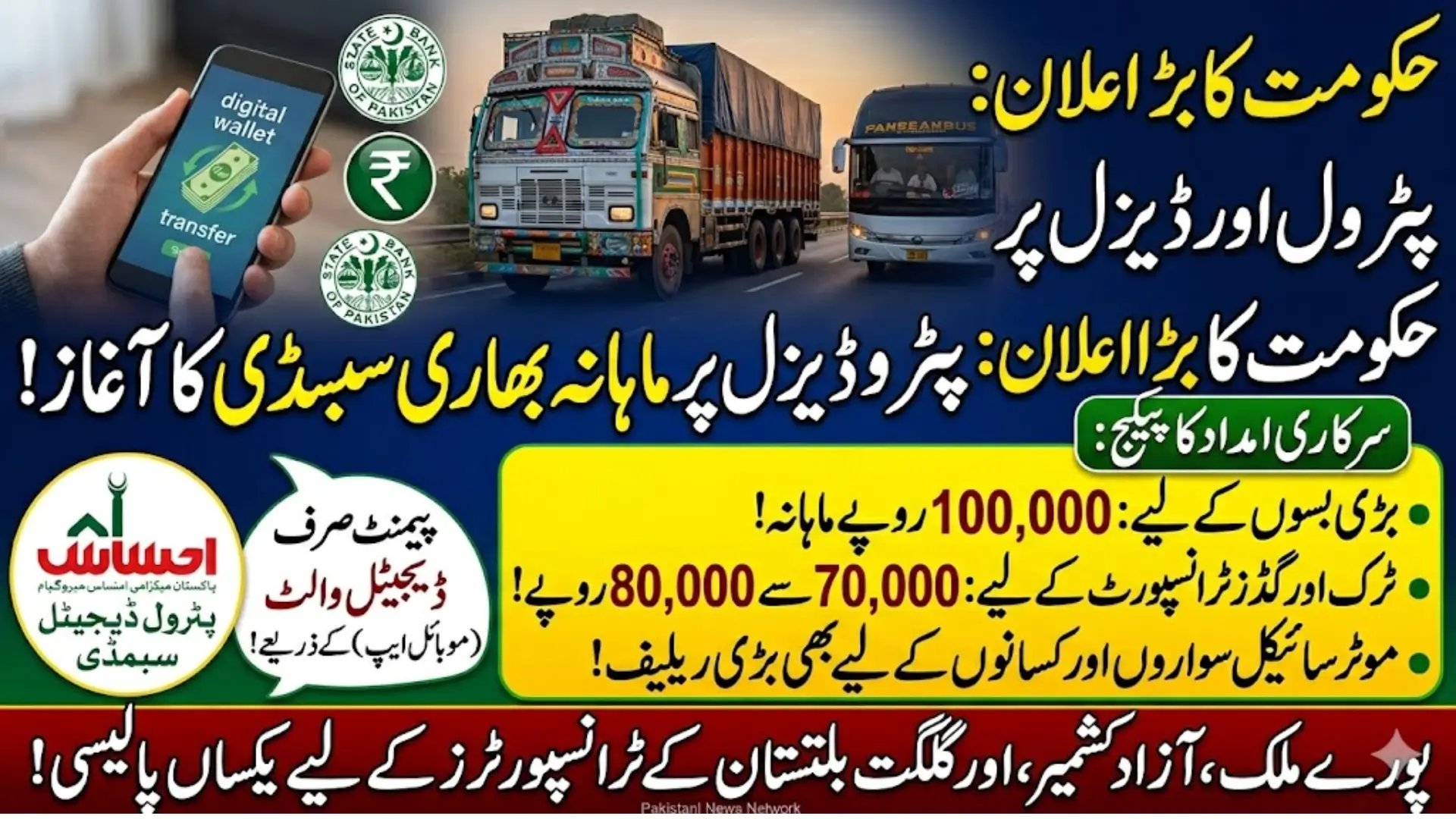
Fuel Crisis Relief Govt Announces Massive Monthly Subsidies
Fuel Crisis Relief Govt Announces Massive Monthly Subsidies: In a landmark policy move aimed at easing the burden of rising fuel costs, the Pakistani federal government has officially launched a digital subsidy disbursement program targeting the country’s heavy transport sector. The initiative marks a significant shift from conventional cash-based relief methods to a transparent, tech-driven payment model through verified digital wallets.

This move is being viewed as one of the most progressive steps taken in Pakistan’s transport finance history, combining fiscal relief with digital governance modernization Federal IT Minister Shaza Fatima Khawaja confirmed the commencement of the first phase of transfers, emphasizing that all payments are now being routed directly into registered digital wallets.
The decision was finalized after a high-level meeting chaired by the Prime Minister, attended by representatives from all four provinces, who unanimously agreed to participate in the subsidy framework. Transport data was collected from provincial excise departments and subsequently forwarded by the Ministry of Information Technology to the State Bank of Pakistan for processing and payment execution.
You Can Also Read: BISP 8171 Web Portal 2026 Online Payment Check & New Updates
| Vehicle Category | Monthly Subsidy |
|---|---|
| Public Service Buses | Rs. 100,000 |
| Cargo & Freight Trucks | Rs. 70,000 – 80,000 |
| Motorcyclists | Rs. 100 / Litre |
| Farmers (Agri) | Direct Provincial Relief |
Monthly Fuel Relief Package: How Much Are Bus and Truck Owners Getting?
The financial relief being offered under this scheme is substantial. The government has structured the subsidy amounts based on the type and role of each vehicle in the transport ecosystem, ensuring that those who carry the greatest commercial burden receive proportional support. Public service buses, which directly impact daily commuters, have been assigned the highest monthly support figure, given their role in keeping urban and intercity fares stable and affordable.
Cargo and freight vehicles, which form the backbone of Pakistan’s supply chain and commodity distribution network, are also receiving significant monthly allocations. The government’s aim is to prevent rising fuel costs from being transferred to consumers through higher transportation charges on goods, a chain reaction that typically accelerates inflation across multiple sectors of the economy.
You Can Also Read: Benazir Taleemi Wazaif Registration Start Know How to Apply Online
Key Subsidy Amounts at a Glance
- Public service buses will receive Rs. 100,000 per month to keep passenger fares from increasing
- Cargo trucks and goods transport vehicles are allocated between Rs. 70,000 and Rs. 80,000 per month
- Motorcyclists will receive Rs. 100 per litre subsidy through provincial government channels
- Farmers will receive direct provincial subsidies for fuel-related agricultural needs
- Transport operators in Azad Kashmir and Gilgit-Baltistan are also included in the national relief program
Federal vs Provincial Role: Who Pays What in the New Subsidy Framework?
One of the most carefully designed aspects of this program is the clear demarcation of responsibilities between the federal government and provincial administrations. Rather than placing the entire financial weight on a single tier of government, the framework distributes the responsibility across multiple levels ensuring that both national and regional needs are addressed simultaneously without overburdening any one authority.
Under this arrangement, the federal government has taken the lead in funding heavy freight and long-haul transport, including trucks, buses, and large cargo vehicles. Provincial governments, on the other hand, are responsible for smaller vehicle categories such as motorcycles and agricultural transport used by farmers. This division of roles is not merely administrative it reflects a broader philosophy of participatory governance in which all stakeholders share ownership of the economic relief program.
You Can Also Read: BISP 8171 Camp System 2026 Payment Released How Beneficiaries
Division of Subsidy Responsibilities
- Federal government covers: freight trucks, public buses, large transport units, and heavy commercial vehicles
- Provincial governments cover: motorcyclists and farmers within their respective territories
- Federal government additionally supports motorcyclists in federally administered areas, Azad Kashmir, and Gilgit-Baltistan
- All four provinces have formally agreed to participate and contribute to provincial-level disbursements
Digital Wallet Payments: A Step Toward Transparent and Targeted Relief Distribution
The decision to channel subsidies through digital wallets rather than physical cash or conventional banking transfers carries deep implications for how public financial relief is administered in Pakistan. Digital wallet payments create an auditable, traceable record of every transaction, dramatically reducing the risk of funds being misappropriated, delayed, or misdirected. For a country that has historically struggled with subsidy leakage and targeting inefficiency, this shift represents a meaningful governance upgrade.
The IT Ministry’s role in this process goes beyond simply overseeing technology deployment. By aggregating transport data from provincial excise departments and channeling it to the State Bank of Pakistan, the Ministry has essentially built a real-time digital pipeline connecting local-level vehicle registration records with federal financial systems. This integration is the foundation upon which future digital-first welfare programs can be modeled.
You Can Also Read: BISP 8171 CNIC Online Check 2026 New Payment Step by Step Guide
National Coverage: Why Azad Kashmir and Gilgit-Baltistan Are Being Included
A particularly notable dimension of this relief program is its geographic scope. Unlike previous subsidy initiatives that were often limited to the four main provinces, this scheme has been explicitly extended to Azad Kashmir and Gilgit-Baltistan two territories with distinct administrative and economic profiles. Transport operators in these regions have long faced challenges tied to terrain, limited road infrastructure, and higher fuel consumption rates due to mountainous routes.
By including these regions in the national relief framework, the government is signaling a commitment to equitable economic inclusion. The logistics industry in these areas relies heavily on trucks and buses for supply chains that serve some of the country’s most geographically isolated communities. The extension of subsidies to these regions is not only a financial decision but also a strategic one helping to sustain supply lines, reduce regional price disparities, and prevent further economic marginalization of peripheral territories.
Broader Impact on Inflation Control and Public Transport Fares
The timing of this initiative is significant. Pakistan has been grappling with persistent inflationary pressure, much of it driven by elevated energy costs that ripple through every segment of the economy. When fuel prices rise, transport costs increase, which in turn pushes up the price of virtually every commodity that requires physical delivery from food and medicine to industrial raw materials and consumer electronics.
Expected Economic and Social Benefits
- Prevention of fare hikes on public buses, protecting daily wage earners and low-income commuters
- Stabilization of freight costs, which helps contain the secondary inflation triggered by rising transport charges
- Support for the informal transport economy, where owner-operators often operate on thin margins
- Encouragement of digital financial inclusion as more transport workers register for and use digital wallet systems
- Improved government visibility into subsidy utilization through digital audit trails
You Can Also Read: BISP Suspended Accounts Verification 2026 Know Blocked Payment Solution
Conclusion
government has indicated that the scope of this program will not remain static. While the current phase focuses on heavy transport vehicles and motorcyclists in federally administered areas, officials have confirmed that future phases will broaden the coverage further. The groundwork being laid today in terms of data pipelines, digital wallet infrastructure, and inter-departmental coordination between the IT Ministry, State Bank, and provincial excise departments is designed to scale.
This program represents more than just a fuel subsidy. It is an early proof-of-concept for Pakistan’s aspirations toward digitized social protection systems. If the first phase delivers on its promises of speed, accuracy, and transparency, it could become the template for how the country distributes targeted financial support whether for energy relief, agricultural input subsidies, or emergency welfare payments.